January 9, 2023
Sources: - https://nandland.com/uart-serial-port-module/ - https://www.electronicwings.com/raspberry-pi/raspberry-pi-uart-communication-using-python-and-c
UART stands for universal asynchronous receiver-transmitter. An UART is a computer hardware that facilitates asynchronous serial communication.
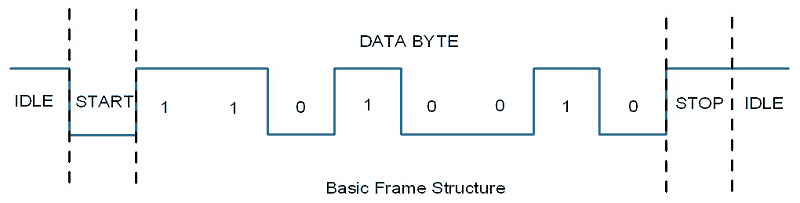
UARTs usually send information bit by bit. Starting from the least significant to the most significant one.
There're usually 3 major components in a UART:
For these examples we're going to use:
This means that each bit will be sent in
10,000,000 / 125000 = 80 clock cycles.
module uart_transmiter(
  input clock,
  input reset,
  input has_incoming_data,
  input [7:0] incoming_byte;
  output start_bit;
  output stop_bit;
  output bit;
);

  parameter CLOCKS_PER_BIT = 80;

  enum {IDLE, START_BIT, PROCESSING, STOP_BIT, RESET} status = IDLE;
  reg [7:0] payload = 8'b0;

  always @(posedge clock or posedge reset) begin
    case (status)
      IDLE:
        begin
          start_bit <= 1'b1;
          stop_bit <= 1'b1;
          if (has_incoming_data)
            begin
              status <= START_BIT;
            end
          else
            begin
              status <= IDLE;
            end
        end

      START_BIT:
        begin
          start_bit <=

    endcase
  end


endmodule