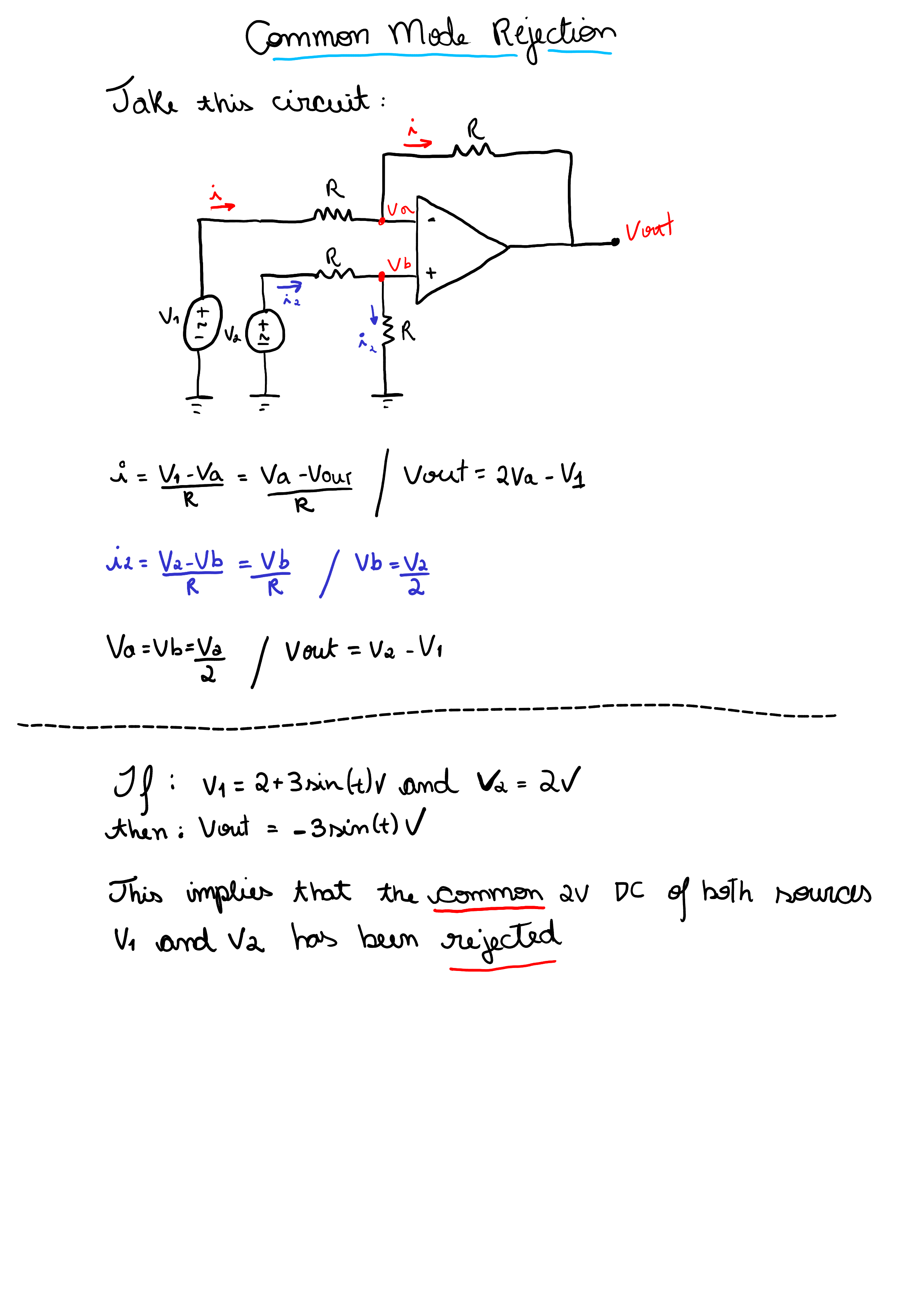
Created at: 2025-11-27
In electronics, the common mode rejection ratio (CMRR) of a differential amplifier (or other device) is a metric used to quantify the ability of the device to reject common-mode signals, i.e. those that appear simultaneously and in-phase on both inputs. An ideal differential amplifier would have infinite CMRR, however this is not achievable in practice. (wikipedia).
In electrical engineering, a common-mode signal is the identical component of voltage present at both input terminals of an electrical device. In telecommunication, the common-mode signal on a transmission line is also known as longitudinal voltage.
Why do we need to reject "common mode signals"?
In electrical engineering, a common-mode signal is the identical component of voltage present at both input terminals of an electrical device. In telecommunication, the common-mode signal on a transmission line is also known as longitudinal voltage.
This is a measure of how well a differential amplifier can reject common-mode signals. A higher CMRR indicates a better ability to suppress unwanted noise.